
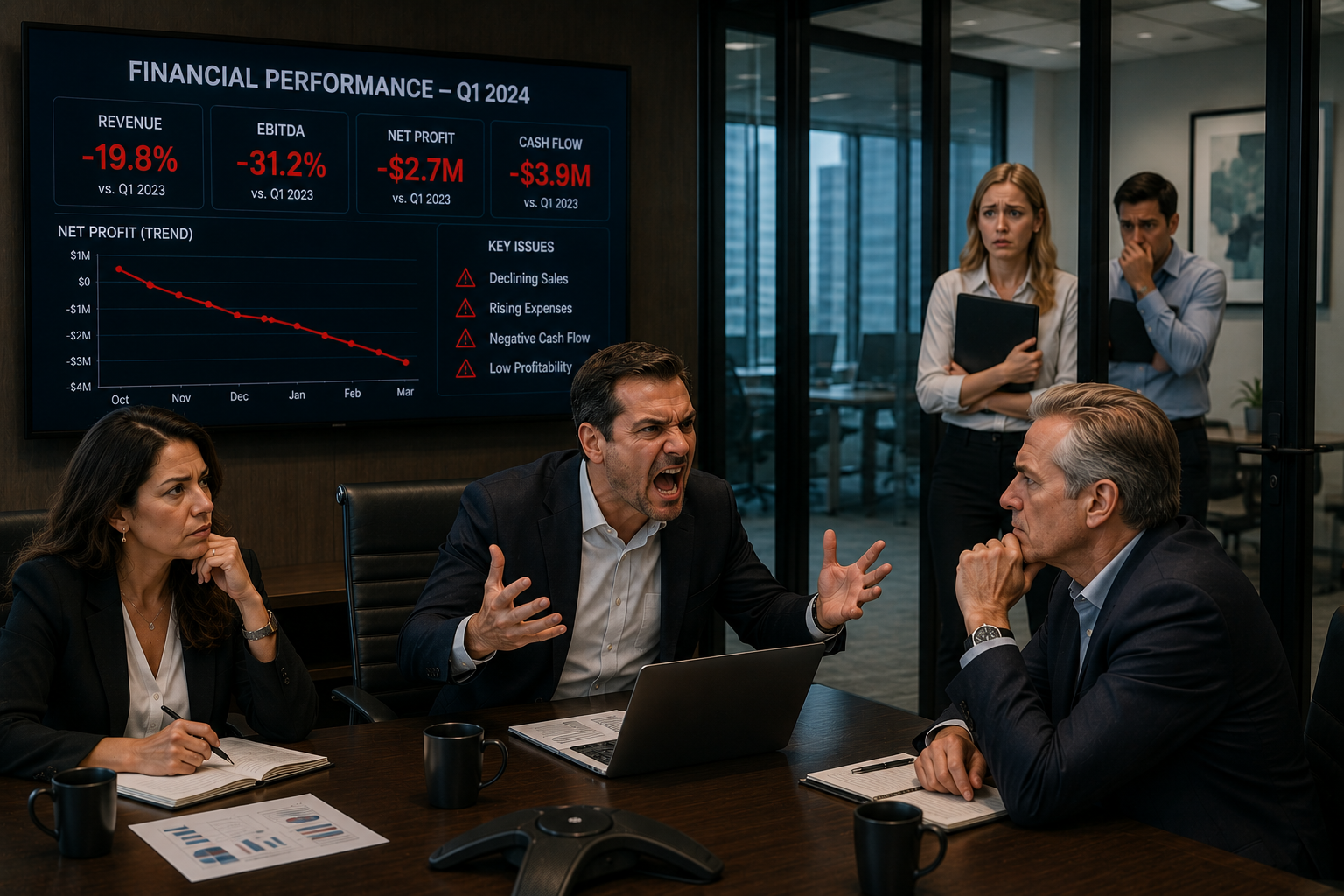
Most businesses don’t collapse suddenly.
They wear down gradually.
At first, the pressure feels temporary.
A difficult month.
A delayed payment.
A demanding client.
A tighter cash flow cycle.
The business keeps operating.
But over time, something invisible starts accumulating:
And unlike operational problems, financial fatigue is dangerous because businesses often normalize it before realizing how much damage it is causing.
What Financial Fatigue Really Looks Like
Financial fatigue is not always dramatic.
It usually appears quietly:
- constant financial pressure
- recurring liquidity problems
- permanent urgency
- reactive decision-making
- mental exhaustion from uncertainty
The business still functions.
Sales continue.
Operations move.
People stay busy.
But internally, the organization slowly loses clarity, energy, and control.
Why Businesses Normalize Financial Pressure
One of the biggest dangers is adaptation.
Businesses adapt to pressure so gradually that abnormal situations start feeling normal.
For example:
- constantly waiting for collections
- negotiating payment extensions every month
- depending on future sales to cover current obligations
- operating with permanent cash tension
At some point, this stops feeling temporary.
It becomes the operating model.
And that’s where fatigue begins weakening the business structurally.
When I Saw This Happen in Real Business
I once saw this pattern clearly while working with businesses that managed large operational flows across multiple bank accounts and continuous payment cycles.
Operationally, the companies looked highly active.
Every day involved:
- payments
- collections
- reconciliations
- negotiations
- urgent operational decisions
From the outside, everything appeared dynamic and under control.
But underneath, the financial structure was becoming increasingly exhausted.
Liquidity management was based more on short-term reactions than on understanding how money was actually moving through the business.
Teams became used to:
- constant urgency
- unresolved reconciliations
- delayed financial visibility
- pressure-driven decisions
And over time, financial fatigue stopped being perceived as a warning sign.
It simply became “normal.”
That normalization is extremely dangerous.
Because businesses rarely collapse from one single event.
They weaken slowly while operating under constant pressure for too long.
Why Financial Fatigue Reduces Decision Quality
Fatigue affects judgment.
When businesses operate under permanent pressure:
- analysis becomes superficial
- urgency dominates strategy
- long-term thinking disappears
Not improvement.
And when that happens, businesses start making decisions designed to reduce immediate discomfort instead of strengthening financial structure.
The Hidden Operational Impact
Financial fatigue does not stay only in finance.
It spreads into operations.
Over time:
- teams become reactive
- coordination weakens
- planning deteriorates
- stress affects execution
Even strong operational businesses begin losing efficiency when financial pressure remains unresolved for too long.
Because uncertainty consumes attention.
And attention is one of the most valuable resources inside any company.
Why Growth Doesn’t Always Solve It
Many businesses believe growth will eliminate pressure.
But if financial fatigue already exists, growth often amplifies it.
Because:
- more activity creates more complexity
- more sales demand more working capital
- more operations require stronger control systems
Without financial clarity, growth adds weight to an already stressed structure.
And eventually, the organization becomes larger—but weaker.
The Shift: From Constant Pressure to Financial Stability
Financially healthy businesses do not eliminate pressure completely.
What they eliminate is chronic instability.
They build:
- visibility
- predictability
- stronger liquidity management
- healthier decision-making processes
That changes the environment completely.
Because once pressure stops dominating daily operations, businesses recover the ability to think strategically again.
What Financial Stability Actually Feels Like
Financial stability is not the absence of challenges.
It is the absence of constant desperation.
It looks like:
- clearer decisions
- healthier cash flow cycles
- less reactive operations
- more predictable planning
- stronger control over liquidity
And perhaps most importantly:
The business stops surviving month to month…
and starts operating intentionally.
Final Thought
Financial fatigue rarely appears overnight.
It accumulates slowly through pressure, uncertainty, and reactive decisions.
And the danger is not only financial.
It’s strategic.
Because exhausted businesses stop thinking clearly long before they stop operating.
That’s why understanding the dynamics of money is not just about protecting profitability.
It’s about protecting the long-term strength of the business itself.