
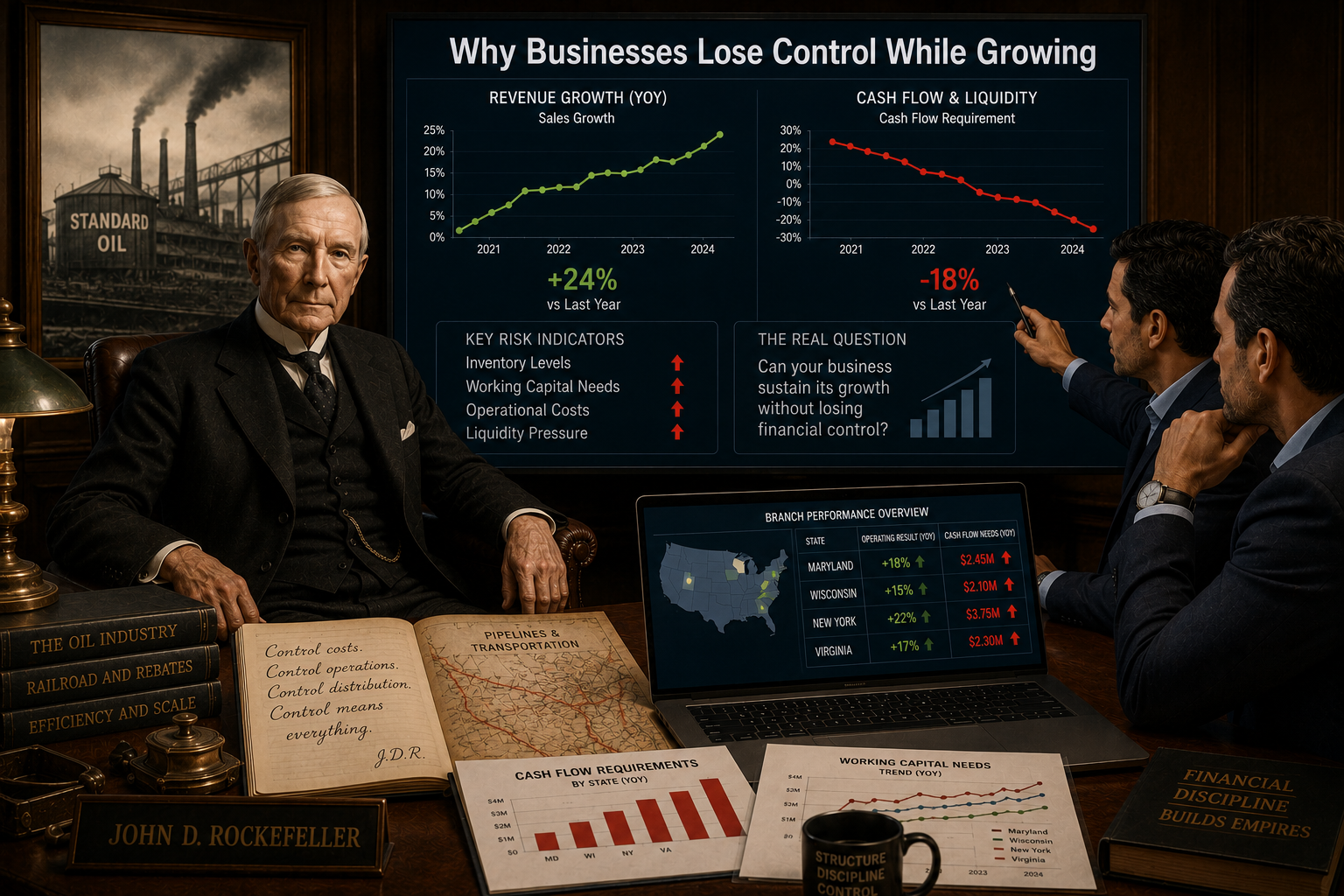
What Rockefeller Understood About Costs, Liquidity, and Expansion Long Before Modern Financial Theory
Growth creates excitement.
More sales.
More movement.
More opportunities.
And because of that, many businesses assume that expansion automatically means improvement.
But financially, growth can become dangerous very quickly when control disappears underneath the surface.
Because businesses rarely collapse from lack of activity.
They usually weaken from losing visibility, liquidity, and operational balance while trying to grow faster.
Why Growth Often Creates Hidden Instability
Expansion increases pressure everywhere inside a business.
More sales usually require:
- more inventory
- more operational coordination
- more financing
- more working capital
- faster decision-making
From the outside, growth appears positive.
But underneath, complexity starts accelerating.
And if the financial structure is not strong enough, the business slowly begins losing control of its own operation.
The Mistake Many Businesses Make
Many companies approach growth emotionally.
The logic becomes:
- “sell more”
- “expand faster”
- “take advantage of the opportunity now”
But growth without structure creates fragility.
Because:
- liquidity becomes tighter
- operational pressure intensifies
- dependence on future cash increases
And eventually, the company becomes larger…
but financially weaker.
What Rockefeller Seemed to Understand Exceptionally Well
One of the most interesting things about Rockefeller was that his success was not built only on oil.
It was built on control.
Long before modern financial management theories existed, Rockefeller appeared to understand something many businesses still ignore today:
Profitability means very little if operational structure and financial control are weak.
Instead of focusing only on selling more oil, he became obsessed with:
- reducing operational costs
- improving efficiency
- controlling transportation
- stabilizing supply structures
- protecting margins through operational discipline
That changed everything.
Because while many competitors focused mainly on expansion, Rockefeller focused on building systems capable of sustaining expansion.
And that distinction matters enormously.
Why Control Matters More Than Speed
Businesses often believe speed creates competitive advantage.
And sometimes it does.
But uncontrolled growth creates hidden deterioration underneath:
- cash gets trapped
- operational errors increase
- visibility weakens
- pressure intensifies
The company keeps moving.
But internally, the structure becomes more fragile.
This is one of the reasons many fast-growing businesses suddenly run into severe financial problems despite strong sales.
When I Saw This Logic in Real Business
I remember situations where companies aggressively pursued commercial opportunities because market conditions looked highly favorable.
The instinct was understandable:
grow quickly before the opportunity disappeared.
But underneath, the financial structure was already under pressure.
Inventory exposure increased.
Liquidity became tighter.
Operations became more difficult to coordinate.
And the more movement increased, the harder it became to clearly understand how money was actually behaving underneath the operation.
That experience reminded me of something important:
Businesses rarely lose control because of one single bad decision.
They lose control gradually when expansion starts moving faster than financial understanding.
Why Strong Businesses Think Differently About Growth
Financially strong businesses do not grow blindly.
They constantly evaluate:
- whether liquidity can support expansion
- whether operational pressure is becoming excessive
- whether working capital is deteriorating
- whether visibility is weakening underneath growth
Because sustainable growth requires more than ambition.
It requires structure.
The Difference Between Expansion and Strength
Expansion increases size.
Strength increases stability.
And businesses often confuse the two.
A company can:
- expand rapidly
- generate impressive sales
- create massive operational movement
…and still become financially vulnerable underneath.
That is why financially intelligent businesses focus less on appearing bigger…
and more on becoming structurally stronger.
The Shift: From Aggressive Growth to Controlled Growth
Controlled growth does not mean avoiding ambition.
It means protecting:
- liquidity
- visibility
- operational balance
- decision quality
It means understanding that sustainable expansion depends not only on opportunity…
but on how much pressure the business can absorb without losing control.
Final Thought
Rockefeller did not build an empire simply by selling oil.
He built it by understanding control, efficiency, structure, and financial discipline at a level many businesses still underestimate today.
And that lesson remains incredibly relevant.
Because businesses rarely fail from lack of ambition.
They fail when growth moves faster than their ability to financially sustain it.