

For many businesses, the problem is not sales.
It is not profitability either.
On paper, everything seems to be working.
Revenue is growing.
Margins look acceptable.
And yet, there is a constant feeling:
Cash is always tight.
This is where many entrepreneurs start looking for answers—and eventually come across a concept that explains much more than it seems:
The cash conversion cycle.
The Hidden Flow Behind Every Business
Every business operates through a simple cycle.
It buys.
It sells.
It collects.
But between these steps, something happens that is often overlooked:
Time.
Cash leaves the business first—and only returns later.
That gap is where financial pressure is created.
The cash conversion cycle simply measures that gap.
What the Cash Conversion Cycle Really Means
In simple terms, the cash conversion cycle answers one question:
How long does it take for a business to turn its investments into cash?
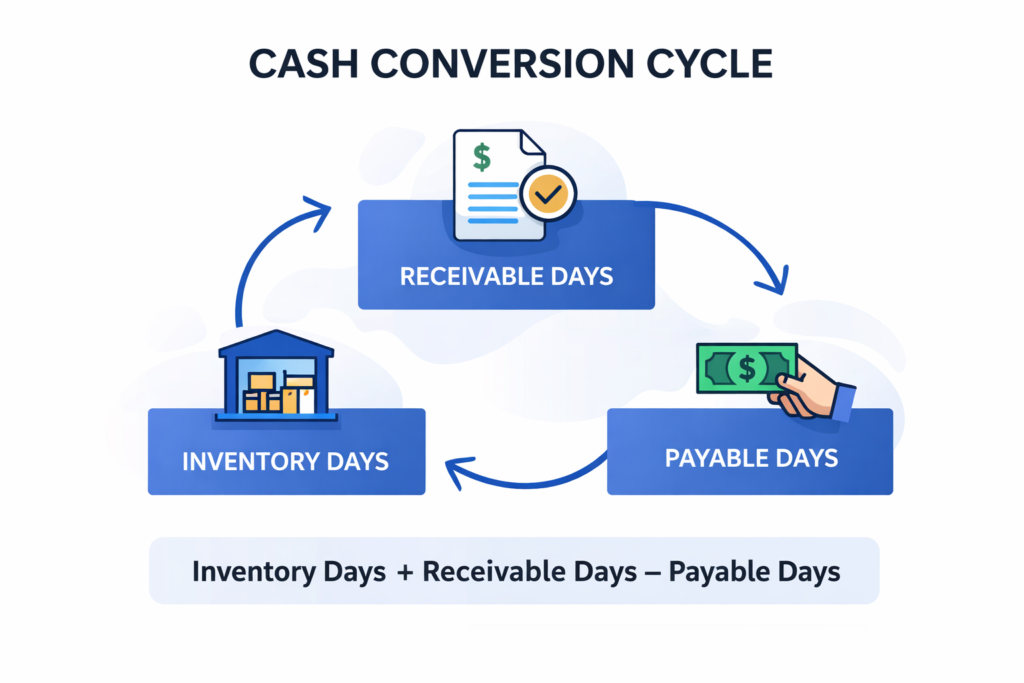
It is calculated using three elements:
- Inventory days → how long products sit before being sold
- Accounts receivable days → how long customers take to pay
- Accounts payable days → how long the business takes to pay suppliers
The formula looks like this:
Cash Conversion Cycle = Inventory Days + Receivable Days − Payable Days
But the formula is not the important part.
What matters is what it represents.
Why This Cycle Matters More Than You Think
A short cycle means:
Cash returns quickly.
The business needs less financing.
Operations feel smoother.
A long cycle means:
Cash is tied up for longer.
The business must finance its operations.
Pressure starts to build.
This is the same dynamic behind why growing sales can destroy your cash flow.
Because growth often increases inventory and receivables—but not necessarily cash.
A Simple Example
Imagine a business that:
- Holds inventory for 60 days
- Collects from customers in 45 days
- Pays suppliers in 30 days
Its cash conversion cycle would be:
60 + 45 − 30 = 75 days
That means the business must finance 75 days of operations before seeing cash again.
Now imagine sales double.
The cycle does not disappear.
It expands.
And so does the need for cash.
This is why many profitable businesses still run out of cash.
Where Most Businesses Lose Control
The problem is rarely one single element.
It is the combination.
- Inventory grows “just in case”
- Customers take longer to pay
- Suppliers demand faster payment
Individually, each decision seems reasonable.
Together, they stretch the cycle.
And that is where financial tension begins.
Improving the Cycle (Without Complicating It)
Improving the cash conversion cycle is not about complex strategies.
It comes down to three simple ideas:
- Sell faster (reduce inventory time)
- Collect sooner (reduce receivable days)
- Pay smarter (optimize payable terms)
These are the same levers behind working capital management.
Small improvements in each area can significantly reduce pressure on cash.
A Different Way to Look at Your Business
Most business owners focus on:
- sales
- margins
- growth
Few focus on how long cash takes to return.
But that is often the real constraint.
Not demand.
Not competition.
Not even profitability.
Liquidity.
Final Reflection
The cash conversion cycle is not just a formula.
It is a way of understanding how a business breathes.
Some businesses grow fast but struggle to sustain themselves.
Others grow more slowly—but with control.
The difference is not always strategy.
It is timing.
Because in the end, a business does not fail because it sells too little.
It fails when the cash required to sustain those sales takes too long to come back.