
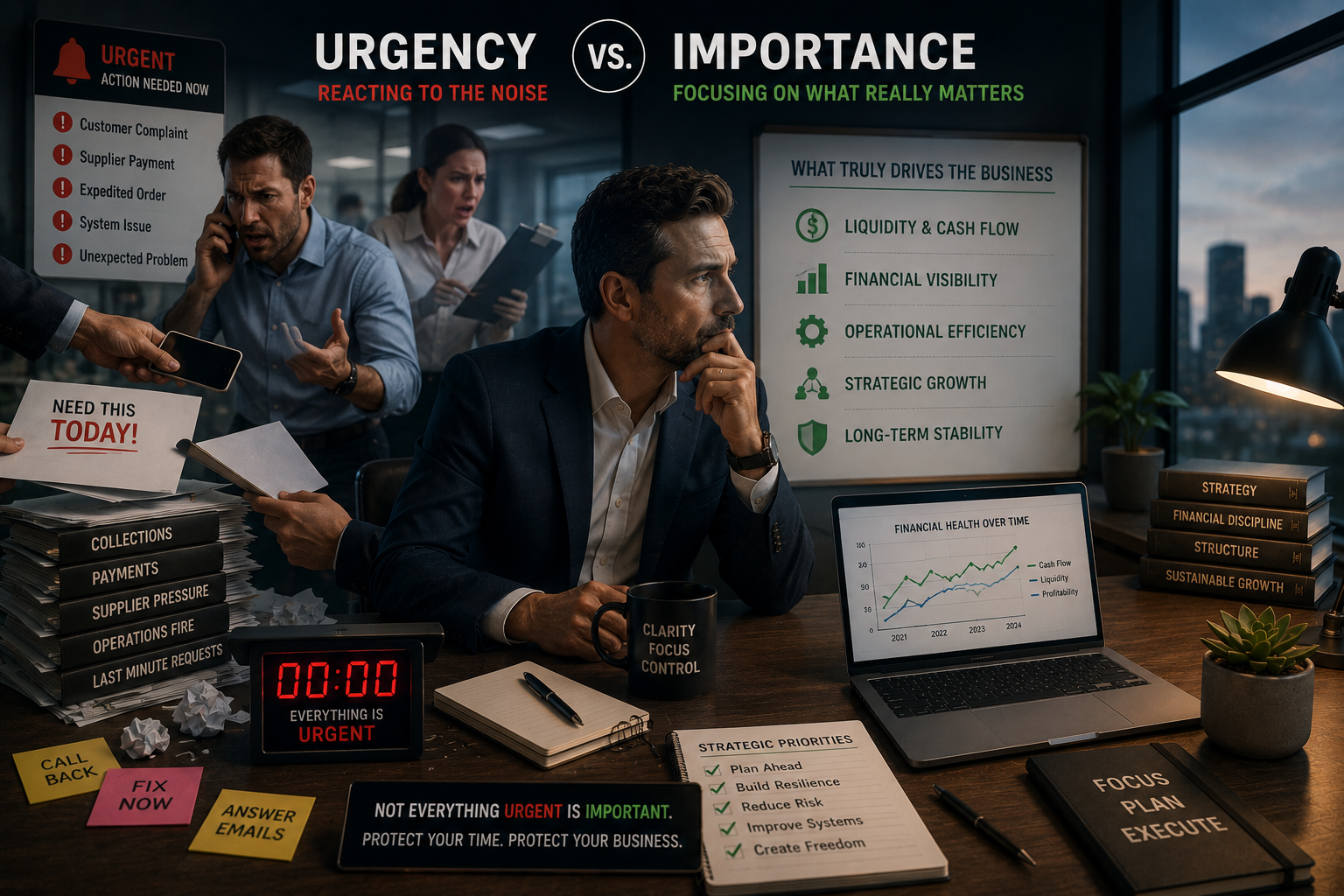
In many businesses, urgency dominates everything.
Calls must be answered immediately.
Problems must be solved quickly.
Requests keep appearing constantly.
Operations never seem to slow down.
And because of that, many organizations slowly begin treating urgent situations as if they were automatically important.
But urgency and importance are not the same thing.
And confusing the two quietly damages decision-making, financial clarity, and long-term stability.
Why Urgency Feels So Powerful
Urgency creates emotional pressure.
It demands immediate attention.
People naturally react faster when:
- pressure increases
- deadlines tighten
- clients complain
- operational problems appear
And operationally, reacting quickly often feels productive.
The business appears active and responsive.
But reacting constantly is not always a sign of good management.
Sometimes it is a sign that the business has lost strategic control underneath daily operations.
The Problem With Operating in Permanent Urgency
Many businesses become trapped in continuous reaction mode.
Every day feels urgent:
- collections
- payments
- operational requests
- supplier pressure
- unexpected problems
Over time, organizations stop asking:
- “What truly matters strategically?”
…and start focusing only on:
- “What needs immediate attention right now?”
That shift changes the quality of decisions dramatically.
Because important decisions usually require:
- analysis
- visibility
- perspective
- calm evaluation
Urgency rarely allows any of those things.
Why Important Problems Often Receive Less Attention
One of the biggest dangers in business is that important problems are rarely loud at the beginning.
For example:
- weakening liquidity
- deteriorating visibility
- growing operational complexity
- unhealthy dependence on future sales
- gradual financial fragility
These problems usually develop slowly.
They do not create immediate emotional alarms.
And because of that, businesses postpone dealing with them while reacting to daily operational pressure instead.
Eventually, the urgent consumes all available attention.
And the important remains ignored until it becomes critical.
How Constant Urgency Weakens Financial Thinking
Financial thinking requires distance.
It requires the ability to observe:
- patterns
- trends
- structural weaknesses
- long-term consequences
But businesses operating under permanent urgency lose that capacity gradually.
Decision-making becomes:
- reactive
- emotionally driven
- short-term oriented
The organization becomes extremely busy…
while slowly losing clarity underneath.
Why Some Businesses Become Addicted to Urgency
Urgency also creates psychological stimulation.
Fast decisions and constant activity generate the feeling that:
- people are solving problems
- management is highly involved
- operations are moving aggressively
And over time, businesses can unconsciously normalize chaos.
Calm environments start feeling “unproductive.”
This is dangerous.
Because sustainable businesses usually operate with:
- stronger visibility
- better anticipation
- healthier planning
- less emotional pressure
Not more chaos.
The Hidden Financial Cost of Constant Reaction
Reactive businesses usually experience:
- weaker liquidity control
- lower operational efficiency
- more financial errors
- poorer long-term planning
- increasing internal pressure
Not because management lacks intelligence.
But because urgency consumes attention before strategic thinking can happen.
And attention is one of the most limited resources inside any organization.
The Difference Between Reactive and Strategic Businesses
Reactive businesses ask:
- “What problem is exploding right now?”
Strategic businesses ask:
- “What future problem is quietly forming underneath current operations?”
That difference changes everything.
Because financially mature businesses understand that preventing structural problems is far less expensive than constantly reacting to operational emergencies later.
The Shift: From Constant Reaction to Strategic Clarity
Financially strong businesses do not eliminate urgency completely.
Business will always involve pressure.
But they reduce unnecessary urgency by improving:
- visibility
- structure
- liquidity management
- operational coordination
- decision-making systems
That creates something extremely valuable:
Mental space to think clearly.
And businesses that think clearly usually make better long-term decisions.
Final Thought
Urgency creates movement.
But movement is not always progress.
And businesses that constantly react to immediate pressure often fail to notice the deeper structural problems quietly developing underneath operations.
That is why financially intelligent businesses protect something many companies underestimate:
The ability to think beyond the urgent.