
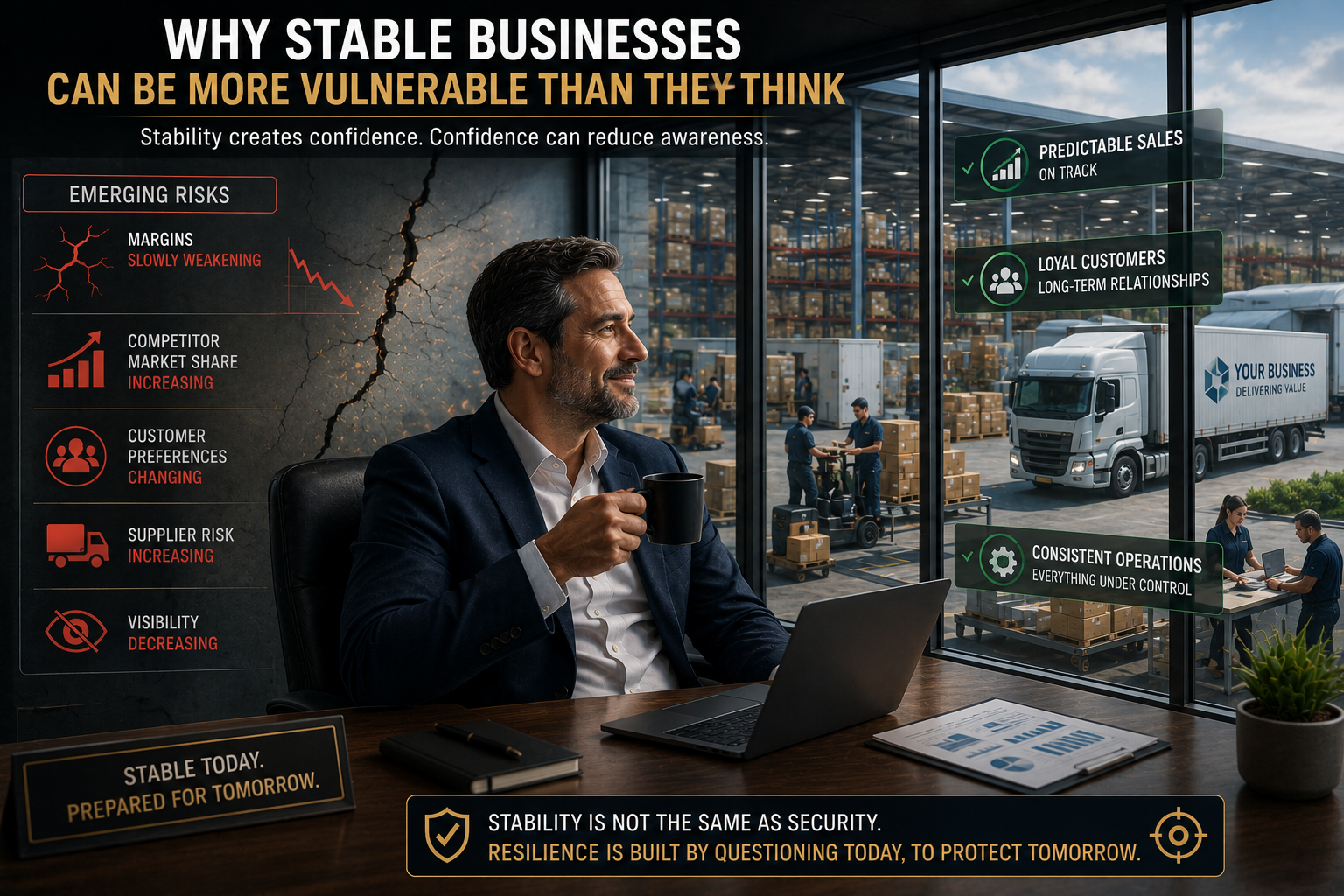
Stability feels comfortable.
Predictable sales.
Long-term clients.
Familiar routines.
Consistent operations.
Most business owners see these signs and assume something important:
“We are stable, therefore we are safe.”
But stability and security are not the same thing.
And in many cases, long periods of stability quietly reduce the attention businesses pay to emerging risks.
Why Stability Creates Confidence
Stability creates certainty.
When the business operates predictably:
- decisions feel easier
- pressure feels lower
- risk appears manageable
And over time, this creates confidence.
The organization starts believing that the future will behave similarly to the past.
Most of the time, that assumption remains unchallenged.
Until conditions change.
The Hidden Risk of Familiarity
The longer a business experiences stability, the more likely it becomes to normalize existing assumptions.
For example:
- customers will continue buying
- suppliers will remain reliable
- costs will stay manageable
- demand will remain consistent
None of these assumptions appear dangerous.
Until they stop being true.
The problem is not stability itself.
The problem is believing that stability guarantees permanence.
Why Businesses Often Miss Slow Changes
Most threats do not arrive suddenly.
They emerge gradually.
A competitor improves.
Customer preferences evolve.
Supplier conditions change.
Operational complexity increases.
Individually, these changes seem insignificant.
Collectively, they can reshape an entire business environment.
And because the changes happen slowly, they rarely trigger immediate action.
The Danger of Looking Only at Results
Many businesses evaluate their health primarily through current performance.
Questions such as:
- Are sales holding up?
- Are profits acceptable?
- Are customers staying?
are important.
But they are incomplete.
Because current results often describe the past.
Not the future.
And businesses that focus exclusively on present performance may fail to detect emerging vulnerabilities.
Why Success Can Delay Awareness
Ironically, success often delays critical thinking.
When results look acceptable:
- fewer questions are asked
- fewer assumptions are challenged
- fewer risks are investigated
The business becomes comfortable.
And comfort can weaken curiosity.
That is dangerous.
Because curiosity is often what reveals future threats before they become visible.
What Financially Intelligent Businesses Do Differently
Strong businesses understand that stability is not an endpoint.
It is a condition that requires continuous evaluation.
They regularly ask:
- What are we assuming?
- What has changed recently?
- What risks are quietly increasing?
- What would happen if current conditions changed tomorrow?
These questions do not create pessimism.
They create preparedness.
The Difference Between Stable and Resilient
A stable business performs well under current conditions.
A resilient business performs well when conditions change.
That distinction matters enormously.
Because markets change.
Customers change.
Costs change.
Competition changes.
And businesses that prepare only for stability often struggle when uncertainty returns.
The Shift: From Comfort to Awareness
Financially mature organizations do not become obsessed with risk.
They simply avoid becoming blind to it.
They remain attentive.
They continue questioning assumptions.
They continue improving visibility.
And they understand that maintaining strength requires more than protecting today’s performance.
It requires preparing for tomorrow’s uncertainty.
Final Thought
Stability is valuable.
But stability should never be confused with safety.
Because many businesses become vulnerable precisely when they stop looking for vulnerabilities.
That is why some of the strongest organizations are not the ones enjoying the most stability today.
They are the ones continuously preparing for change before it arrives.