
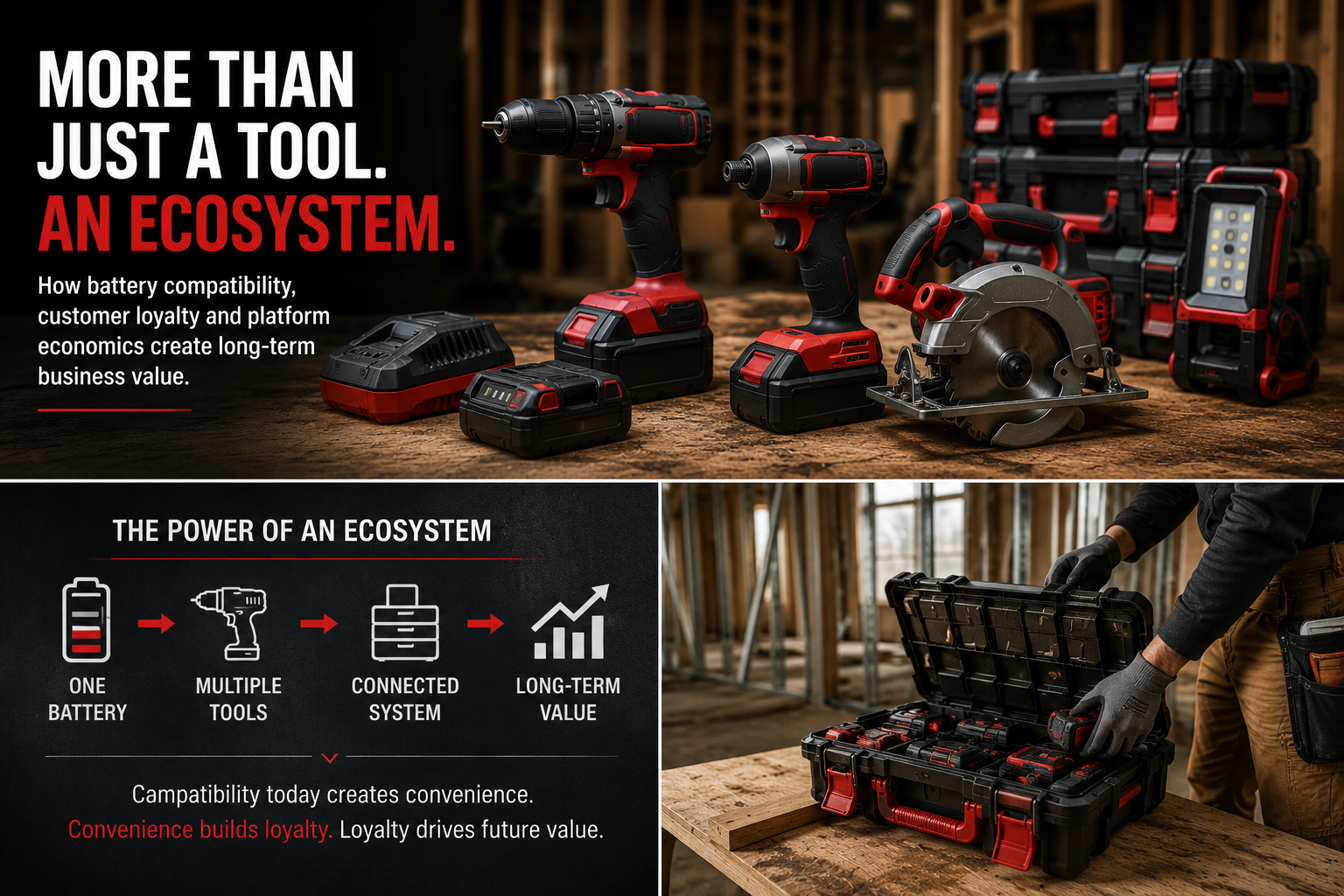
What battery compatibility, customer loyalty and platform economics can teach us about long-term business value
Since moving closer to Milwaukee’s industrial environment, I have started paying much more attention to the businesses and products that surround manufacturing.
And there is one color that is difficult to ignore.
Red.
You see it in factories.
You see it on construction sites.
You see it in hardware stores.
Drills. Impact drivers. Saws. Grinders. Lights. Batteries. Toolboxes. Storage systems.
Milwaukee.
At first, it is easy to look at Milwaukee Tool as simply a successful manufacturer of professional tools.
But the more I looked at the Milwaukee Tool business model, the more interesting it became.
Because Milwaukee isn’t simply trying to sell you a drill.
It is trying to make that drill part of a much larger system.
And financially, that distinction matters enormously.
It raises a question that goes far beyond power tools:
What happens when the first product you sell makes the customer’s next purchase more likely?
The First Tool Is Only the Beginning
Imagine that you need a cordless drill.
You compare several brands.
Eventually, you choose one from Milwaukee’s M18 system.
But you don’t necessarily buy only a drill.
You may also acquire a battery.
And a charger.
Perhaps later you need an impact driver.
Then a circular saw.
Then a grinder.
Then a light.
Then another battery.
Something interesting has happened.
Your original purchasing decision is beginning to influence your future purchasing decisions.
Why?
Because you already own part of the system.
Milwaukee states that all M18 batteries are compatible with M18 tools and chargers. The same principle applies within its M12 system.
That means the battery sitting in your workshop isn’t useful for only one tool.
It is part of an expanding platform.
And that changes the economics of the next purchase.
The Battery Changes the Economics
Suppose you already own several M18 batteries and chargers.
Now you need another cordless tool.
You could certainly evaluate competing brands.
But changing brands may mean more than buying another tool.
It could also mean entering another battery platform.
Another charger.
Another set of batteries.
Another system to maintain.
Staying within your existing platform, on the other hand, may allow you to purchase a compatible tool and immediately use infrastructure you already own.
The battery therefore does something financially interesting.
It creates value beyond its original purchase.
And the larger your collection of compatible tools becomes, the more useful that installed base can become.
Milwaukee has deliberately reinforced this principle.
The company explains that when it introduced its M18 and M12 cordless systems, it made a commitment to continue developing technology without requiring users to abandon their existing platforms.
That is much more than a technical decision.
It can also become a customer-retention mechanism.
Every New Tool Can Make the Ecosystem Stronger
This is where the Milwaukee Tool business model becomes particularly interesting.
A traditional transaction can end when the product leaves the store.
You sell something.
The customer pays.
The transaction is complete.
An ecosystem behaves differently.
The first purchase can create a foundation for the second.
The second can make the third more convenient.
And each additional compatible product can increase the practical value of the products the customer already owns.
Milwaukee has continued expanding the breadth of its cordless systems while maintaining compatibility.
In announcing newer REDLITHIUM FORGE batteries, for example, the company said those batteries were fully compatible with more than 275 M18 solutions.
Think about what that means from the customer’s perspective.
The decision is no longer simply:
Which tool should I buy?
It can increasingly become:
Which tool can I add to the system I already have?
That is a very different competitive position.
Customer Loyalty Can Be Designed Into the Product
Businesses often talk about customer loyalty as if it were primarily a marketing problem.
Build a recognizable brand.
Run advertising.
Create an emotional connection.
Offer rewards.
Provide good service.
All of those things can matter.
But Milwaukee illustrates another possibility.
Customer loyalty can also emerge from product architecture.
If a contractor already owns multiple tools, batteries and chargers within one platform, compatibility itself creates economic value.
Remaining within the ecosystem can be convenient.
It can reduce duplication.
It can simplify charging.
It can simplify equipment management.
And it can allow existing batteries to support future purchases.
That doesn’t mean the customer is trapped.
The customer can always choose another brand.
But leaving an ecosystem becomes a different economic decision from replacing an isolated product.
The existing installed base now matters.
And this is where product design begins to influence customer economics.
The Ecosystem Goes Beyond Batteries
The same logic becomes even more interesting when we look beyond cordless tools.
Milwaukee has expanded into lighting, accessories, hand tools, storage and other solutions designed around professional trades.
Its PACKOUT modular storage system provides another example of ecosystem thinking.
Instead of treating a toolbox as an isolated container, PACKOUT components are designed to connect with other components in the system.
Milwaukee currently describes the platform as having more than 125 solutions, with components that can be combined and customized for jobsites, vehicles and shops.
Again, the principle is similar.
One product doesn’t necessarily stand alone.
It becomes more useful because other products can connect to it.
This is what ecosystems do well.
They turn individual products into components of a larger proposition.
But Building an Ecosystem Isn’t Free
From the customer’s perspective, compatibility looks simple.
Insert the battery.
Connect the storage box.
Use the tool.
Behind that simplicity, however, sits substantial investment.
Milwaukee explains that it made the strategic decision to design, develop and manufacture its own battery packs and motors while investing in electrical engineering capabilities to develop its electronics.
That requires engineers.
Product development.
Testing.
Manufacturing capabilities.
Technology.
Tooling.
Distribution.
Inventory.
And continuous innovation.
The company cannot simply launch new technology without thinking about what millions of existing products already in customers’ hands mean for the platform.
That creates an important financial tension.
Compatibility can strengthen customer value.
But maintaining and expanding that compatibility requires resources.
The ecosystem therefore has to generate enough economic value to justify the investment required to keep strengthening it.
The Financial Power of the Next Purchase
This changes the way we should think about the value of a customer.
Imagine two businesses.
The first sells a product for $300 and never sees the customer again.
The second sells a $300 product that becomes the beginning of a relationship in which the customer later buys additional tools, batteries, accessories and storage products.
The original revenue might be identical.
The economic value of the customer is not.
This is where Customer Lifetime Value becomes much more interesting than the value of the first transaction.
A business built around isolated transactions constantly has to win another sale.
A business built around a strong ecosystem may still have to compete for every purchase, but previous purchases can help create the conditions for future ones.
That distinction matters.
Because growth isn’t only about acquiring more customers.
It can also come from creating more value with the customers you already acquired.
The First Sale Can Change the Cost of the Second
There is another financial implication.
Acquiring a new customer costs money.
Marketing.
Distribution.
Retail presence.
Promotions.
Sales efforts.
Brand building.
But once a customer already understands the platform, owns compatible products and trusts the system, the economics of the next sale may be different.
The business doesn’t necessarily have to introduce itself again from zero.
The customer already knows what the red battery on the shelf can do.
That doesn’t eliminate competition.
But it can reduce some of the friction surrounding another purchase.
And when multiplied across a large customer base, that can become economically powerful.
The first product generates revenue.
The ecosystem creates the possibility of recurring revenue.
There Is Also a Risk
Ecosystems are powerful precisely because customers expect them to remain ecosystems.
That creates responsibility.
If a company repeatedly makes existing equipment obsolete, customers may begin to question the value of committing to the platform.
Imagine buying several batteries and tools only to discover that the next generation requires an entirely different system.
The customer doesn’t only evaluate the new tool.
They begin reevaluating their previous investment.
That is why Milwaukee’s commitment to continuing technological development without forcing users to change platforms is strategically important.
Compatibility protects more than functionality.
It can protect trust in the customer’s previous investment.
And trust can have financial value.
What Smaller Businesses Can Learn From Milwaukee Tool
A small or midsized business obviously cannot replicate Milwaukee Tool’s engineering capabilities, product catalog or distribution network.
And it shouldn’t try.
But it can ask the same strategic question.
Does our first sale make the second sale easier?
Perhaps you sell industrial components.
Could compatible replacement parts create continuity?
Perhaps you sell equipment.
Could accessories expand the usefulness of the original product?
Perhaps you sell software.
Could additional modules become more valuable because the customer already uses the core system?
Perhaps you distribute products.
Could a carefully designed assortment allow customers to solve more problems through one supplier?
The lesson isn’t:
Build a battery platform.
The lesson is:
Think beyond the individual transaction.
A product can generate revenue.
But a system can create a relationship.
And relationships can change the economics of growth.
The Question I Would Ask If This Were My Business
I wouldn’t begin by asking:
How can we sell more products?
I would ask:
What can we sell today that makes our customer more likely to buy from us tomorrow?
That question changes product strategy.
It changes how we think about customer acquisition.
It changes how we think about product development.
It changes how we think about retention.
And ultimately, it changes how we think about the financial value of a customer.
Because not every sale has the same strategic value.
Some sales end when the transaction ends.
Others create the beginning of something much larger.
Final Thought
What fascinates me about Milwaukee Tool isn’t simply the number of tools it sells.
It is how individual products can become more valuable when they belong to a broader system.
A battery powers more than one tool.
A charger supports future purchases.
A storage component connects with others.
And every additional product can deepen the usefulness of the ecosystem the customer already owns.
That creates a very different way of looking at growth.
The objective isn’t necessarily to maximize the value of one transaction.
It may be to build a system in which one good purchasing decision naturally creates reasons for another.
So the next time you see a Milwaukee drill, don’t just look at the drill.
Look at the battery underneath it.
Look at the other tools around it.
Look at the system.
Because the most valuable product may not be the one sitting in the customer’s hand.
It may be the reason that customer comes back.
The first tool creates a sale.The ecosystem creates the next one.