
What the Model T Can Teach Us About Cost, Productivity, and Redesigning a Business System
Imagine you’re running a business and customers keep telling you the same thing:
“I like your product. I just can’t afford it.”
What would you do?
Lower your margin? Negotiate harder with suppliers? Cut expenses?
More than a century ago, Henry Ford pursued a more ambitious answer.
Instead of asking only:
“How can I sell this car for less?”
Ford and his team attacked a deeper problem:
How can we change the economics of making it?
That distinction helped transform manufacturing.
Ford Had a Price Problem — But Cutting Prices Wasn’t the Solution
When the Model T appeared in 1908, Ford wanted to make automobiles accessible to a much larger market.
But wanting an affordable product doesn’t make it economical to produce one.
If you simply lower the selling price while everything behind the product remains equally expensive, eventually the business absorbs the difference.
Ford’s organization attacked the other side of the equation.
The product mattered.
But so did the system producing it.
What Happened Inside Highland Park
In 1913, Ford introduced the integrated moving assembly line into automobile production at Highland Park.
Instead of workers repeatedly moving around the automobile, production increasingly brought the work to them.
The impact was dramatic.
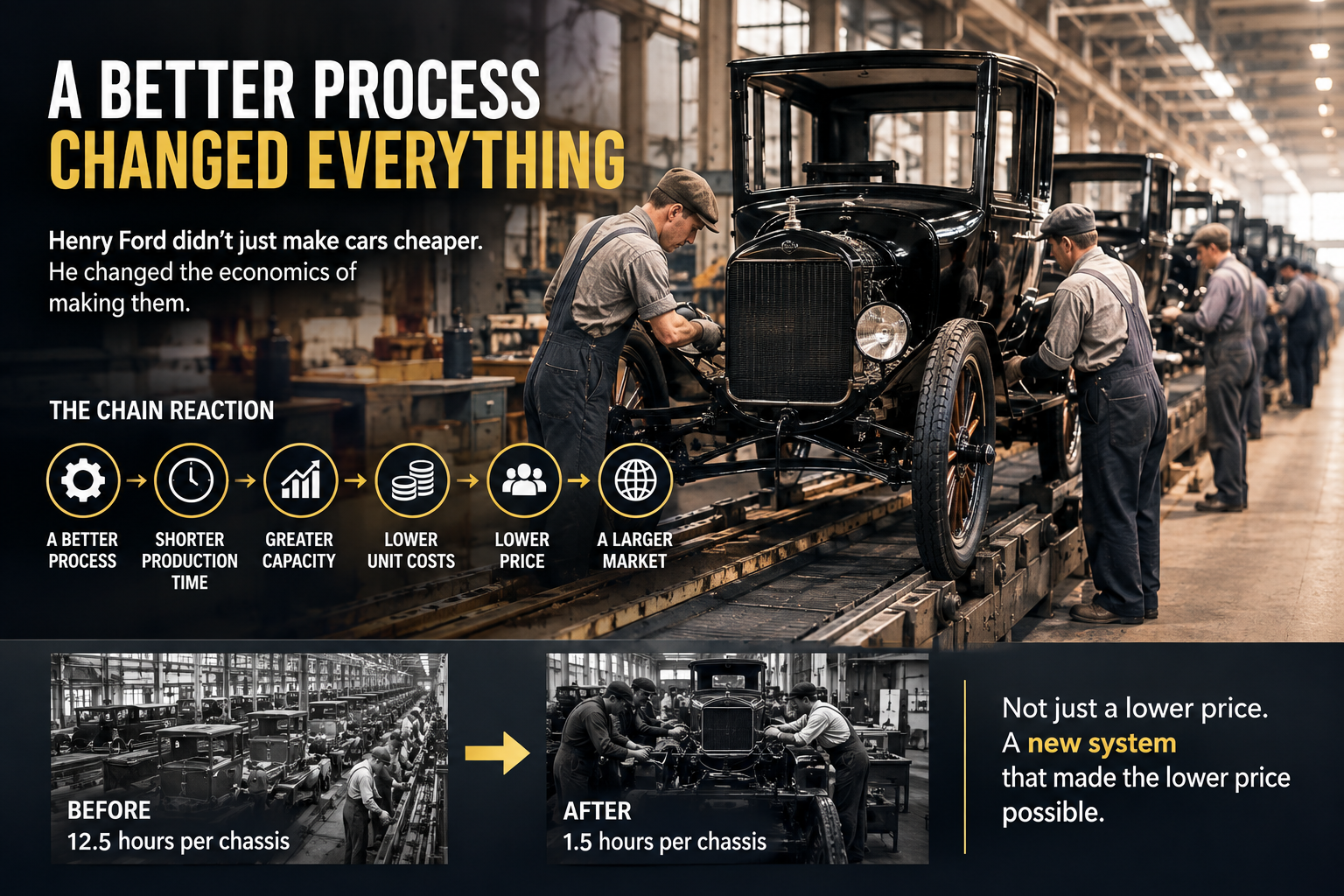
Ford reports that Model T chassis assembly time eventually fell from approximately 12.5 hours to 1.5 hours.
Think about that financially.
This wasn’t simply about making employees work harder.
Ford was changing the relationship between:
- labor,
- time,
- equipment,
- capacity,
- volume,
- and cost per vehicle.
The factory could produce dramatically more with the resources available to it.
And that changed what Ford could charge customers.
He Didn’t Just Lower the Price. He Changed What Made the Price Possible.
The Model T initially sold for around $850. By 1925, the price had fallen to roughly $260. More than 15 million Model Ts were eventually produced.
We could summarize the story as:
Assembly line → cheaper car → more sales.
But financially, something more interesting happened:
Better process → shorter production time → greater capacity → lower unit economics → lower price → larger market → greater volume.
Ford wasn’t simply accepting less profit to sell a cheaper automobile.
He helped create a production system capable of supporting a radically different price.
That is an entirely different strategy.
Sometimes the Problem Isn’t Your Price
I’ve seen businesses spend enormous energy discussing price.
Can we charge 5% more?
Can purchasing negotiate another 3%?
Where can we cut costs?
Those questions matter.
But sometimes they’re too small.
If the underlying operating model is inefficient, another percentage point may not solve much.
Ford’s story suggests a more uncomfortable question:
Why does our business require this much money, time, inventory or labor to produce each dollar of value?
A distributor might find the answer in inventory.
A service company might find it in workflow.
A manufacturer might find it on the production floor.
The lesson isn’t to copy Ford’s assembly line.
It’s to question whether the economics you inherited are really the economics you have to accept.
Efficiency Created Another Problem
Ford’s transformation also shows why business decisions can’t be analyzed in isolation.
The assembly line increased productivity enormously, but the repetitive work contributed to serious employee turnover.
In 1914, Ford introduced its famous $5 workday, significantly increasing compensation for qualifying workers while moving toward an eight-hour workday. The shorter shifts also helped make three-shift production possible.
So Ford solved one economic problem and encountered another.
Production became more efficient.
But the workforce needed to remain stable enough to operate the system.
That’s an important business lesson:
Every optimization affects something else.
Cut inventory too aggressively and service may suffer.
Push productivity too far and turnover may rise.
Increase availability and working capital may expand.
Business isn’t about maximizing one variable.
It’s about understanding how the variables interact.
Margin Isn’t the Whole Story
This is also why I wouldn’t judge Ford’s lesson only through margins.
Imagine two businesses.
One earns more on every sale but produces slowly and keeps substantial resources tied up.
The other earns somewhat less per unit but moves products faster and uses its capacity repeatedly.
Which creates more value?
Margin alone cannot answer that.
You also need to know how much capital, labor and time were required to produce the return.
Profitability isn’t only about how much you make. It’s also about what you had to commit—and for how long—to make it.
And Even Ford’s System Had a Limit
There is one final part of the story worth remembering.
By the mid-1920s, competition and consumer preferences were changing.
Ford’s extraordinarily efficient Model T system could not guarantee that customers would indefinitely want the same product.
Model T production ended in 1927 after more than 15 million vehicles.
That’s perhaps the most interesting warning in the entire story.
You can build an incredibly efficient machine.
But if the market changes, being exceptionally efficient at yesterday’s solution won’t necessarily save you.
Final Thought
Henry Ford became famous for making automobiles affordable to millions.
But financially, I think the deeper lesson is different.
He didn’t just change the price of the automobile. He changed the economics behind the price.
That’s a question worth taking back to almost any business:
Before fighting for another percentage point of margin, another price increase or another cost reduction, look underneath the numbers.
Maybe the greatest opportunity isn’t hidden in the price.
Maybe it’s hidden in the system producing it.