
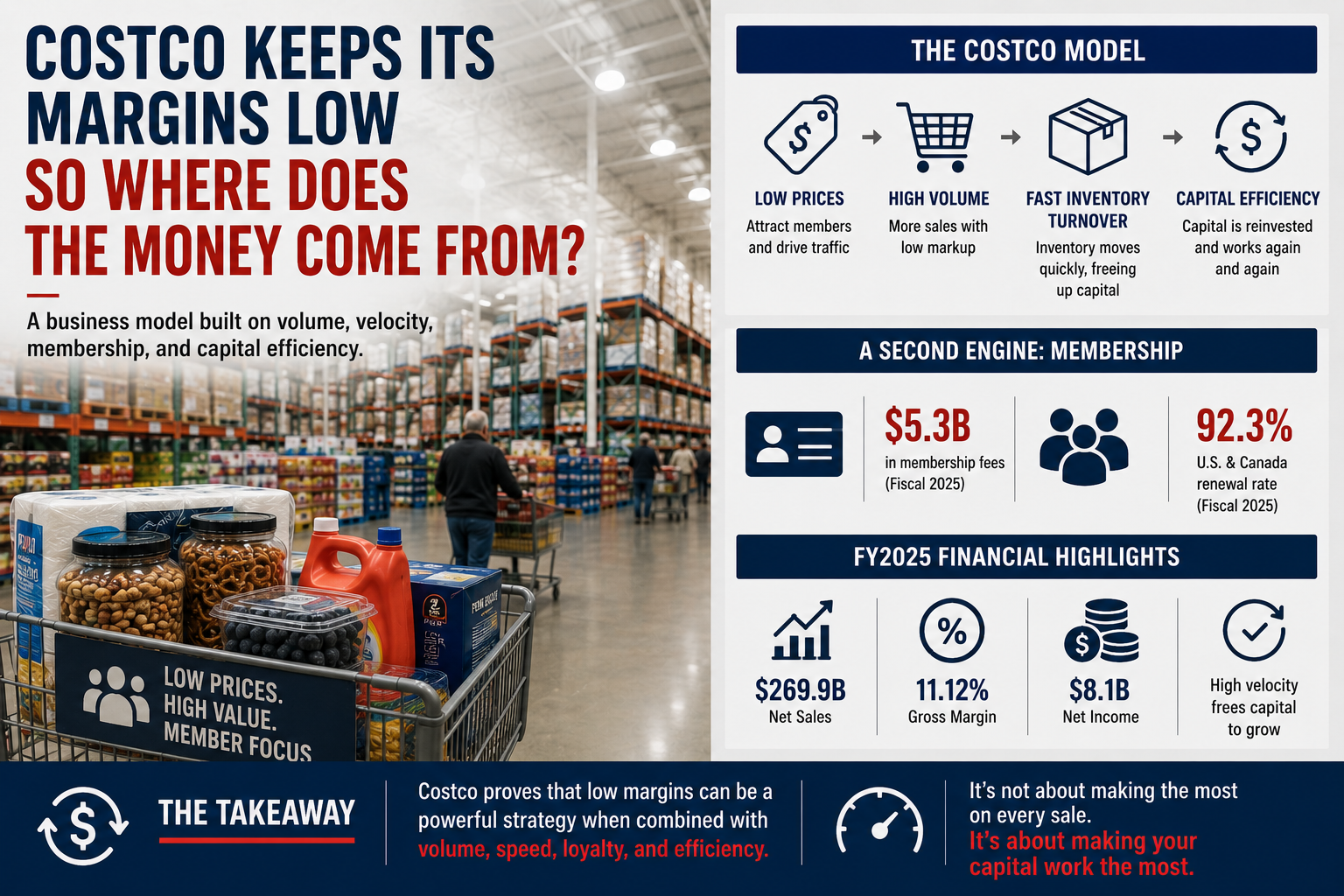
What Costco’s Business Model Can Teach Us About Margin, Inventory Turnover, Memberships, and Capital Efficiency
Walk into Costco and something feels almost contradictory.
The stores aren’t luxurious.
Products often sit on pallets.
The selection is surprisingly limited compared with traditional supermarkets or large retailers.
And the prices are deliberately aggressive.
From a traditional business perspective, you might ask:
Why would a company intentionally make less money on each dollar of merchandise it sells?
But that’s the wrong question.
The more interesting question is:
What if earning less on each sale helps the entire business make more money?
That is where Costco becomes financially fascinating.
Costco Isn’t Trying to Win the Margin Game
Costco’s strategy isn’t a secret.
The company itself says its model is based on offering low prices on a limited selection of products to generate high sales volumes and rapid inventory turnover.
And the numbers show how unusual that model is.
In fiscal 2025, Costco generated approximately $269.9 billion in net sales.
Its gross margin on those sales was only 11.12%.
Think about that for a moment.
Many businesses spend enormous amounts of energy trying to increase margin.
Costco deliberately operates a model where relatively low merchandise margins are part of the proposition.
Why?
Because margin is only one way money creates value.
Speed is another.
What If the Same Dollar Could Work More Than Once?
Imagine you invest $100 in inventory.
Business A sells it once during the year and makes a very attractive margin.
Business B earns less on the transaction but sells, replenishes and sells that inventory repeatedly.
Which business makes better use of the $100?
You can’t answer by looking at margin alone.
You need to know how quickly the capital comes back and gets another opportunity to earn money.
This is what makes Costco’s model so interesting.
Low prices encourage volume.
Volume moves inventory.
Faster inventory movement releases capital.
And that capital can purchase merchandise and begin the cycle again.
Costco isn’t simply asking:
How much can we make on this product?
Its economics also depend on:
How efficiently can we move enormous amounts of merchandise through the system?
Then There Is Something Most Retailers Don’t Have
Costco has another economic engine working alongside merchandise sales:
membership.
In fiscal 2025, membership fees generated approximately $5.3 billion in revenue.
Costco ended that year with about 81 million paid members, and its renewal rate was 92.3% in the U.S. and Canada and 89.8% worldwide.
That’s important because membership changes the relationship between the customer and the retailer.
Before a member even decides whether to buy chicken, detergent, a television or a package containing far too many paper towels, Costco has already created another revenue stream.
And membership gives customers another reason to return:
I’ve already paid to belong here.
The company itself describes membership as integral to its business and profitability.
Low Margin Doesn’t Mean Weak Economics
This is where I think many business owners can misread profitability.
We are naturally attracted to margin.
A 40% margin looks better than 20%.
Twenty percent looks better than 10%.
But that comparison tells us very little unless we also understand what was required to produce those margins.
How much inventory?
How long did it sit?
How much infrastructure?
How frequently did customers return?
How much capital was required?
Costco’s model reminds us that margin cannot be interpreted in isolation.
A lower margin combined with enormous volume, rapid inventory turnover and recurring membership revenue can produce very powerful economics.
Costco reported $8.1 billion in net income in fiscal 2025.
Low merchandise margins clearly don’t mean the company doesn’t make money.
They mean it has chosen a different way of making it.
The Limited Selection Matters Too
There’s another part of Costco’s model that I find particularly interesting.
It doesn’t try to offer endless versions of everything.
Costco explicitly describes its assortment as a limited selection of nationally branded and private-label products.
That matters financially.
Every additional SKU requires something.
Capital.
Shelf space.
Purchasing attention.
Forecasting.
Handling.
Inventory control.
And the possibility that the product doesn’t move as expected.
More variety can create customer value.
But it can also create complexity and trap capital.
Costco makes a deliberate trade-off.
Less choice.
More volume concentrated into fewer items.
That can strengthen purchasing power and simplify the movement of inventory through the system.
Uline and Costco Solve Almost Opposite Problems
This is where comparing business models becomes useful.
In our previous analysis of Uline, enormous product availability is part of the value proposition.
The customer wants to know:
“Do you have exactly what I need?”
Costco approaches retail differently.
Its model essentially says:
“We won’t give you endless choices. But what we do offer should provide compelling value.”
One model creates value partly through breadth and availability.
The other deliberately limits assortment to help support volume and efficiency.
Neither strategy is automatically better.
What matters is whether the capital structure behind the strategy makes sense.
That’s why copying successful companies without understanding their economics can be dangerous.
The Question I Would Take Back to My Own Business
If I were looking at my own product portfolio after studying Costco, I wouldn’t immediately conclude:
“I need lower margins.”
That would completely miss the lesson.
I would ask:
What is my business actually designed to optimize?
Margin per transaction?
Inventory rotation?
Customer frequency?
Recurring revenue?
Availability?
Volume?
Because you usually cannot maximize all of them simultaneously.
The important thing is that the variables reinforce each other.
At Costco:
low prices support volume.
volume supports inventory movement.
limited assortment concentrates purchasing power.
membership supports loyalty and recurring fee revenue.
The pieces belong to the same economic system.
That’s the real lesson.
Final Thought
A higher margin can make a business look more profitable.
But sometimes a lower margin is not a weakness.
It’s a strategic choice.
Costco shows us why profitability should never be judged from a single percentage on an income statement.
The more interesting questions are:
How fast does the money move?
How often does the customer return?
How much capital does the model require?
And what other sources of value reinforce the transaction?
Sometimes the goal isn’t to make the most money every time something leaves the shelf.