
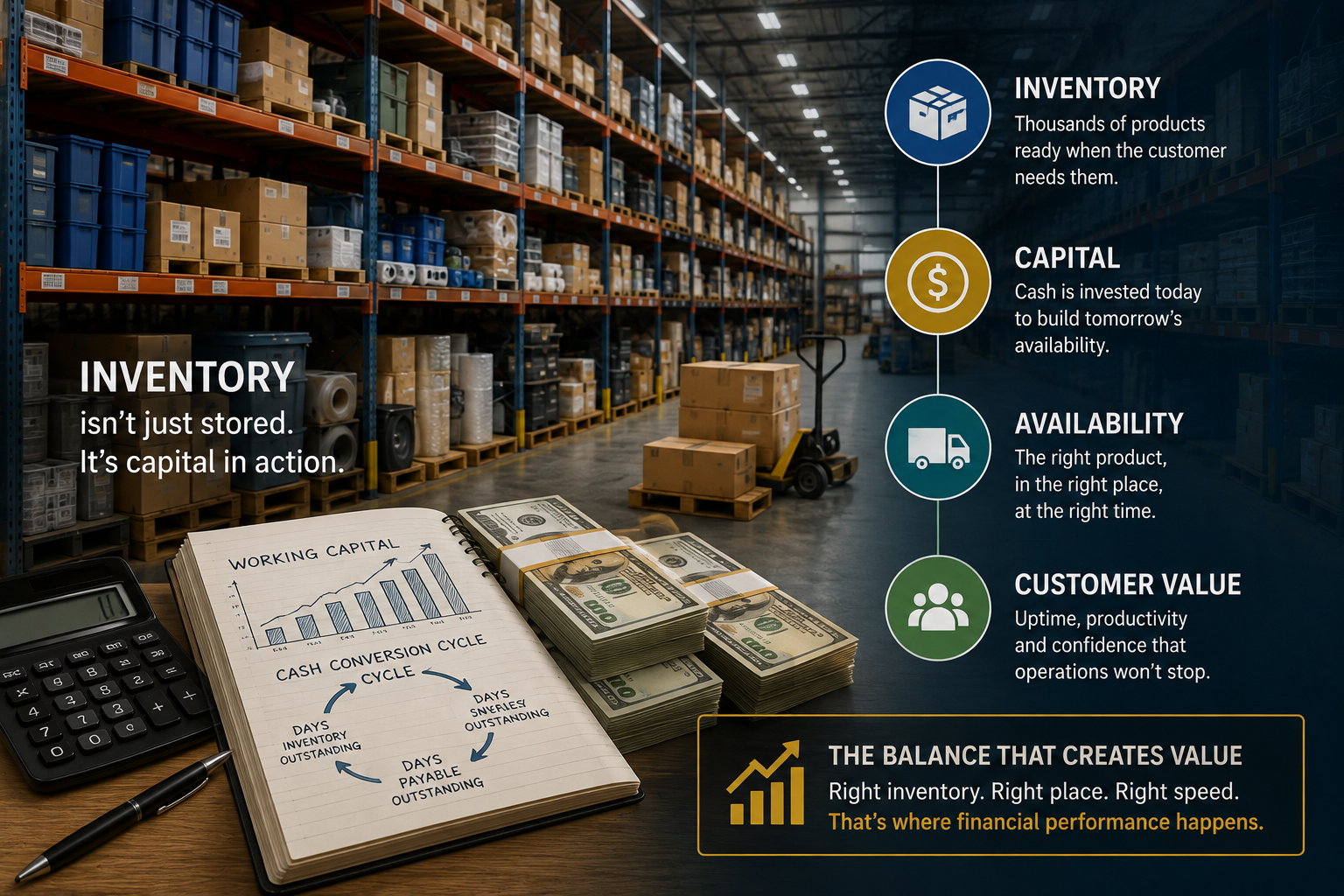
A Financial Look at Inventory, Customer Value, and the Capital Behind Industrial Distribution
Since moving closer to Milwaukee’s manufacturing environment, I have started looking at industrial businesses differently.
Inside a factory, you quickly realize how many seemingly ordinary things are needed to keep operations moving.
Boxes. Labels. Safety equipment. Shelving. Containers. Tape. Material-handling equipment. Packaging supplies.
Individually, many of these products don’t look particularly remarkable.
Until you need one.
And then something interesting happens.
The value of that product is no longer determined only by what it is.
It is determined by whether you can get it when you need it.
That made me look differently at a company I kept seeing around the industrial environment here in Wisconsin: Uline.
And it raised a financial question that I think is much more interesting than simply asking what Uline sells:
How much capital does it take to build a business around the promise of having almost everything your customer might need—available right now?
Uline Isn’t Just Selling Boxes
At first glance, Uline can look like a company that sells shipping and packaging supplies.
But that description misses much of what makes the business model interesting.
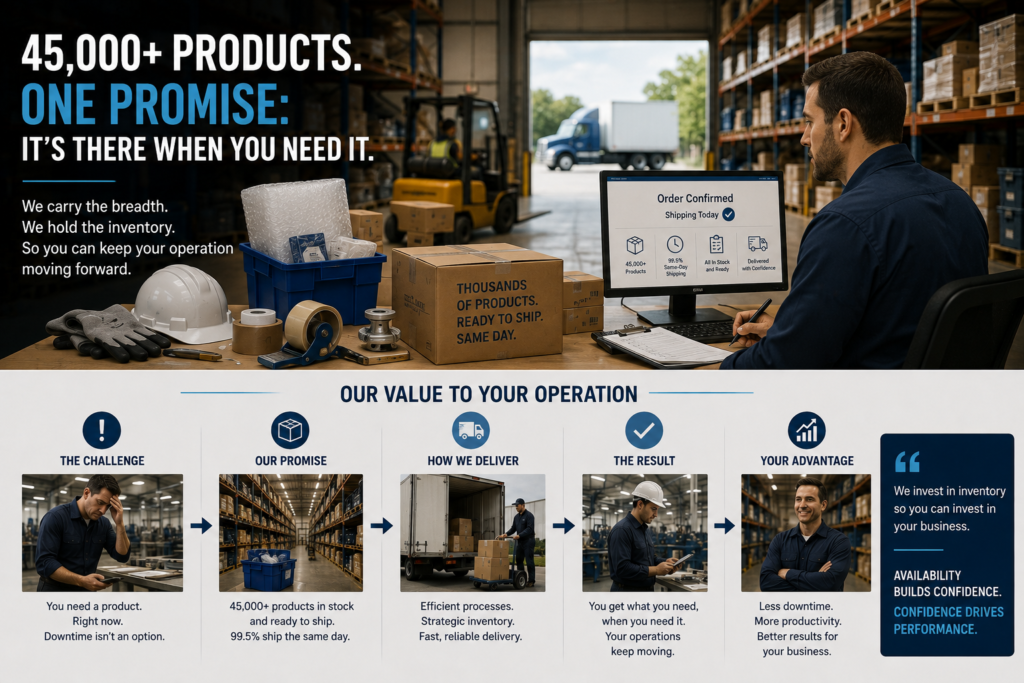
Today, the company says it carries more than 45,000 packaging, shipping, industrial, safety, janitorial, material-handling and related products.
Its promise goes much further than product variety.
Uline says 99.5% of its orders ship the same day.
That changes the way I look at the business.
Because Uline isn’t simply selling products.
It is selling availability.
And availability has a financial cost.
Think About the Customer for a Moment
Imagine you’re managing a factory.
Production is running.
Employees are working.
Orders need to leave.
And suddenly you discover you’re missing something.
Maybe it’s packaging.
Maybe it’s a safety product.
Maybe it’s a container, label, cart, shelving component or warehouse supply.
The item itself might represent a tiny fraction of your company’s total costs.
But not having it at the right moment can create a much larger problem.
That’s where the economics become interesting.
The customer isn’t necessarily buying only the product.
The customer may also be paying for the confidence that someone has already solved the availability problem.
That is a very different value proposition.
But Someone Has to Finance That Promise
This is the part of the model that interests me most from a financial perspective.
A company cannot promise immediate availability across tens of thousands of products without committing substantial resources behind the scenes.
Products have to be purchased.
They have to be stored.
Warehouses have to operate.
Employees have to receive, organize, pick and ship orders.
Distribution networks have to move merchandise.
Technology has to coordinate the system.
And inventory has to exist before the customer asks for it.
That last point matters enormously.
Because inventory sitting on a warehouse shelf is not simply merchandise waiting to be sold.
It is capital waiting to prove that it deserves to be there.
The Financial Tension Behind Great Service
This creates a fascinating tension.
From the customer’s perspective:
More availability is better.
More selection is better.
Fewer backorders are better.
Faster delivery is better.
But from the financial perspective:
More inventory requires more capital.
More SKUs increase complexity.
More facilities increase operating costs.
More availability can increase the amount of money sitting still.
So the same thing that creates customer value can also create financial pressure.
And this is where industrial distribution becomes much more interesting than it appears from the outside.
The objective cannot simply be:
Have more inventory.
It has to be something closer to:
Have the right inventory, in the right place, moving at the right economic speed.
A Warehouse Can Be Full and Still Be Financially Weak
This is something every inventory-based business should think about.
A full warehouse can look impressive.
It can create confidence.
It can even support excellent customer service.
But inventory doesn’t generate value merely because it exists.
It generates value when it moves through the business at an economically attractive rate.
Imagine two products.
One generates a high margin but remains in inventory for months.
Another generates a smaller margin but sells repeatedly throughout the year.
Which one creates more value?
The answer is not always obvious.
Because margin tells us only part of the story.
We also need to understand how much capital was required and how long that capital remained tied up.
That is where inventory stops being merely an operational issue and becomes a financial one.
Uline’s Physical Footprint Tells Us Something
We do not know Uline’s internal inventory investment or inventory turnover because it is a privately held company.
But we can observe the infrastructure supporting its proposition.
Uline operates multiple distribution locations across North America.
Its corporate campus in Pleasant Prairie, Wisconsin, includes two one-million-square-foot warehouses dedicated to supplying regional distribution centers.
Its Chicago-area operation in nearby Kenosha occupies approximately 800,000 square feet and describes itself as fully stocked to support same-day shipping with virtually no backorders.
Those aren’t merely logistics facts.
They tell us something about the economics of the promise.
Speed and availability require infrastructure.
And infrastructure requires capital.
So Where Is the Real Competitive Advantage?
This is where I think the Uline model becomes particularly interesting.
It would be easy to assume its advantage is simply having a large catalog.
But anyone can print a large catalog.
The harder part is making the catalog believable.
If customers repeatedly discover that products are unavailable, the size of the catalog loses much of its value.
So the real competitive advantage may lie deeper:
The ability to coordinate assortment, inventory, warehouses, procurement, people and distribution well enough to make availability economically sustainable.
In other words, the competitive advantage isn’t inventory alone.
It is the system that makes that inventory productive.
And That Changes How We Should Think About Working Capital
Working capital is often discussed as if it were simply a financial ratio.
Current assets minus current liabilities.
Useful?
Absolutely.
But incomplete.
In a business like industrial distribution, working capital is part of the value proposition itself.
Inventory allows the company to say:
“We have it.”
Distribution allows it to say:
“We can ship it.”
Liquidity allows the system to keep operating.
And margin ultimately has to compensate the business for the capital, infrastructure and risk required to make those promises possible.
That is a much more useful way to think about working capital.
Not simply as money trapped inside operations.
But as capital that should be deliberately positioned to create customer value.
The Question I Would Ask If This Were My Business
I wouldn’t begin by asking:
“How can we reduce inventory?”
Nor would I automatically ask:
“How can we increase inventory?”
I would ask:
Which part of our inventory is actually earning the right to consume our capital?
Because some inventory protects sales.
Some improves service.
Some creates competitive advantage.
And some simply sits there consuming:
- space,
- financing,
- insurance,
- handling,
- attention,
- and time.
Those products may look identical on an inventory report.
Financially, they are not.
What Smaller Businesses Can Learn From This
A small or midsized company obviously cannot replicate Uline’s infrastructure.
And it shouldn’t try.
But it can learn from the financial question behind the model.
If your competitive promise depends on having products available, then inventory isn’t merely a purchasing decision.
It is an investment decision.
Every additional SKU competes for capital.
Every additional unit has to justify its place.
Every promise of availability has a cost.
And every dollar sitting in inventory should ultimately contribute to something:
More sales.
Better service.
Higher margins.
Greater customer retention.
Faster growth.
Or stronger competitive positioning.
If it contributes to none of them, you may not be holding an asset.
You may simply be holding money that stopped moving.
Final Thought
What fascinates me about Uline is not that it sells more than 45,000 products.
It is what has to happen financially and operationally for a company to confidently tell customers that those products are ready when they need them.
That promise requires inventory.
Inventory requires capital.
Capital requires returns.
And returns depend not only on how much you earn when something sells, but also on how intelligently your money moves through the business.
So the next time you walk through a warehouse full of products, don’t just see boxes, equipment or merchandise.
Look at the shelves differently.
You are looking at capital.
And every dollar sitting there should eventually be able to answer one question: