
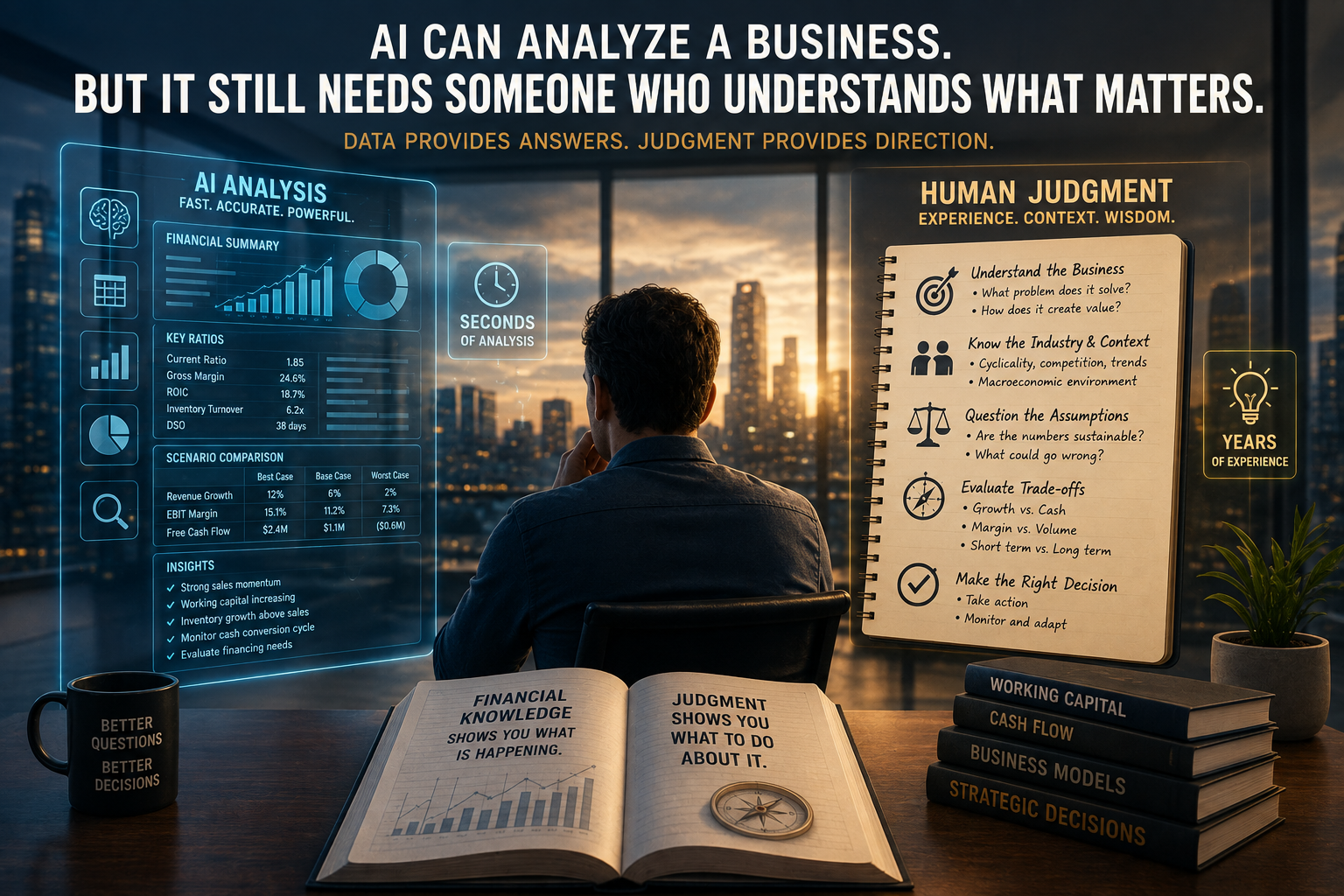
What finance, great businesses, and human judgment can teach us about using artificial intelligence without surrendering our ability to think.
Artificial intelligence – AI – in business can analyze thousands of rows of financial data in seconds.
It can calculate ratios, compare scenarios, identify patterns, summarize financial statements, research competitors, question assumptions, and suggest possible decisions.
Things that once required hours—or sometimes days—can now happen in minutes.
The potential of AI in business is enormous.
That is extraordinary.
But after spending so much time thinking about cash flow, working capital, margins, inventory, business models, and the decisions behind successful companies, I keep coming back to a simple question:
What good is a powerful analytical tool if we don’t understand what its answers actually mean?
Because AI can help us find an answer.
It can even help us find it incredibly fast.
But that doesn’t necessarily mean we should follow it.
The Numbers Can Be Right and the Conclusion Can Still Be Wrong
Imagine giving an AI system the financial information of a growing company.
Sales are increasing.
Profits are positive.
Cash in the bank is higher than last year.
The company appears healthy.
AI could correctly calculate every number.
But what if inventory increased much faster than sales?
What if customers are taking longer to pay?
What if most of the additional cash came from bank financing?
What if growth itself is creating a financing requirement the company will soon struggle to support?
None of the original numbers were necessarily wrong.
The problem was what we believed those numbers meant.
This distinction has always been at the heart of financial judgment.
And AI doesn’t make it disappear.
It may actually make it more important.
AI Can Be Convincing. That’s Part of the Risk.
One characteristic of artificial intelligence deserves particular attention:
It can sound remarkably confident.
If we understand the subject, we can challenge it.
That assumption doesn’t make sense.
You’re ignoring something important.
Those two conclusions contradict each other.
But if we don’t understand the subject, a sophisticated explanation can easily become indistinguishable from a correct explanation.
That’s why AI in business and human judgment creates an interesting paradox:
The easier it becomes to produce analysis, the more valuable the ability to judge that analysis may become.
Financial knowledge doesn’t suddenly become obsolete because a machine can calculate faster than we can.
Knowing how money moves through a business gives us something more important than the ability to calculate.
It gives us the ability to question.
Cash Can Create an Illusion
I’ve seen this long before artificial intelligence entered the conversation.
In my own professional experience, I’ve encountered business owners operating companies ranging from approximately $1 million to $30 million in annual sales.
Some businesses depended heavily on margins.
Others depended more on volume.
But the movement of money itself could create a powerful perception:
We must be doing well.
There were sales.
Money moved through bank accounts.
Customers continued buying.
Sometimes accounting profits reinforced the feeling.
But the visible flow of money didn’t necessarily reveal the complete financial reality.
Capital could be getting trapped in inventory.
Receivables could be growing.
Debt could be financing the apparent liquidity.
Margins could be deteriorating.
Growth itself could be consuming more cash than the business generated.
That’s why making money isn’t necessarily the same as creating sustainable wealth.
And seeing money in a bank account doesn’t tell us whether that money arrived there efficiently—or whether it can safely leave.
Cash tells us something happened. Understanding the business tells us why.
This Is What Business Models Have Been Teaching Us
The same principle appears when we move beyond financial statements and look at actual businesses.
Consider some of the companies and entrepreneurs we’ve explored.
John D. Rockefeller showed us how understanding costs, scale, logistics, and operational efficiency could transform an uncertain industry into a powerful economic system. His advantage wasn’t simply selling more oil. It also came from understanding and controlling the economics surrounding the business.
Uline built a powerful value proposition around availability. But availability doesn’t appear magically. It requires inventory, infrastructure, logistics, systems, and capital.
Milwaukee Tool shows how selling a product can become something larger when tools, batteries, storage, technology, and compatibility create an ecosystem around the customer.
Henry Ford and his team didn’t simply lower the price of a car. They transformed the production system behind the price.
Costco demonstrates that a relatively low merchandise margin can make sense when it belongs to a system built around volume, inventory velocity, limited selection, customer loyalty, and membership revenue.
Different industries.
Different periods.
Different strategies.
But they share something important.
Their success cannot be understood by looking at one number—or even one decision—in isolation.
You have to understand the system.
And behind each of those systems were people making decisions long before artificial intelligence could analyze those decisions for them.
Great Businesses Were Built Before AI
That is worth remembering.
The entrepreneurs who created extraordinary businesses didn’t have an AI assistant capable of analyzing thousands of alternatives in seconds.
They had to observe.
Experiment.
Fail.
Learn.
Imagine alternatives.
Persist.
And make decisions with imperfect information.
Henry Ford didn’t have AI telling his team how to redesign automobile production.
Rockefeller couldn’t ask an algorithm to model every possible configuration of refining, transportation, scale, and distribution.
The businesses we know today were built through thousands of human decisions.
But this doesn’t mean intuition alone created successful companies.
Eventually, every idea had to confront economic reality.
A brilliant product still needed customers.
Growth still needed financing.
Inventory still consumed capital.
Employees still cost money.
Prices still had to coexist with costs.
And sooner or later, value had to be created and captured.
Great businesses were not built by financial formulas alone.
They were built through creativity, observation, knowledge, persistence, and execution—but every successful idea eventually had to make economic sense.
Now Imagine Adding AI to That Human Capability
This is where AI in business becomes genuinely exciting.
Not because it eliminates the need to think.
Because it can accelerate what thinking allows us to do.
We can research markets faster.
AI financial analysis can drmatically reduce the time required to explore what is happening beneath numbers.
Compare competitors faster.
Analyze financial scenarios faster.
Explore alternative business models faster.
Detect patterns faster.
Test assumptions faster.
And investigate ideas that previously might have required resources we simply didn’t have.
For a small business or an individual entrepreneur, that is an extraordinary change.
Capabilities that once belonged mainly to large organizations are increasingly accessible to much smaller players.
But there is an important distinction:
Acceleration is not direction.
AI can help us travel faster.
It shouldn’t automatically decide where we are going.
The Better the Tool, the Better Our Questions Need to Become
Perhaps this is why one of the most important skills in the age of AI in business won’t simply be knowing how to use AI.
It will be knowing what to ask it.
Instead of:
Is my cash position improving?
Perhaps we should ask:
Why is my cash position improving?
Instead of:
Is this product profitable?
Ask:
How much capital, time, and risk are required to produce that profitability?
Instead of:
Should I launch this business?
Ask:
What assumptions would have to be true for this business to work—and which one is most likely to fail?
AI can make each of those questions easier to investigate.
But someone still has to recognize that the question needs to be asked.
That is why AI business decision making should never be separated from human judgment.
That is judgment.
Finance Was Never Just About the Numbers
Perhaps that is also one of the most important lessons behind everything we’ve explored.
Cash flow.
Working capital.
Inventory.
Margins.
Growth.
Capital efficiency.
Business models.
The purpose of understanding these concepts was never simply to become better at calculating them.
It was to become better at seeing what was happening underneath them.
Why can a profitable company run out of cash?
Why can growth make a business financially weaker?
Why can inventory become both an asset and a burden?
Why can a lower-margin model sometimes outperform a higher-margin one?
Why can two businesses with similar sales have completely different economic realities?
Finance gave us a lens for asking those questions.
AI in business analysis can make that lens dramatically more powerful.
But the lens is still useful only if we know where to point it.
And Now the Question Becomes Bigger
Until now, much of our attention has been on understanding businesses better.
How does money move?
Where does capital get trapped?
What makes one business model economically stronger than another?
The growing use of AI in business gives us an extraordinary tool for exploring those questions.
But artificial intelligence is doing something else at the same time.
It is changing the environment in which businesses operate.
It is changing costs.
Jobs.
Customer expectations.
Productivity.
Access to information.
The economics of certain services.
And the capabilities available to very small businesses.
And AI isn’t the only force creating change.
Demographics change.
Technology changes.
Consumer behavior changes.
Regulation changes.
Entire industries change.
That means perhaps we should begin asking a different kind of question.
Not only:
What can AI do for my business?
But something broader:
What is changing around us—and what is that change making possible that wasn’t possible before?
Because change creates friction.
Friction creates problems.
Problems create needs.
And needs can become markets.
Final Thought
For a long time, understanding finance has helped us look beneath the visible surface of a business.
Beyond sales.
Beyond profit.
Beyond the cash sitting in the bank.
Then, looking at businesses like those built by Rockefeller, Ford, Uline, Milwaukee Tool, and Costco helped us see something broader:
Financial reality is part of a much larger business system.
Creativity matters.
Initiative matters.
Persistence matters.
Execution matters.
But eventually, the pieces have to work together economically.
AI in business and AI financial analysis can now help us understand, test, and explore those systems with a speed that previous generations of entrepreneurs could hardly have imagined.
The purpose shouldn’t be to surrender our judgment to a machine.
It should be to expand what our judgment allows us to discover.
The entrepreneurs who built the businesses we study didn’t succeed because they had perfect information.
They observed something others hadn’t.
They questioned assumptions.
They created.
They persisted.
And they found ways to make their ideas work economically.
AI doesn’t have to replace that process.
It may allow us to accelerate it.
And perhaps the next opportunity isn’t simply using AI to understand the businesses that already exist.Perhaps it’s using everything we’ve learned—now amplified by AI—to recognize the businesses that should exist next.